

Dark Nebulae
These targets are defined as much by what they hide as by what they emit, appearing as dense clouds of dust silhouetted against brighter hydrogen fields. Their shapes are often sculptural and strongly influenced by nearby radiation.
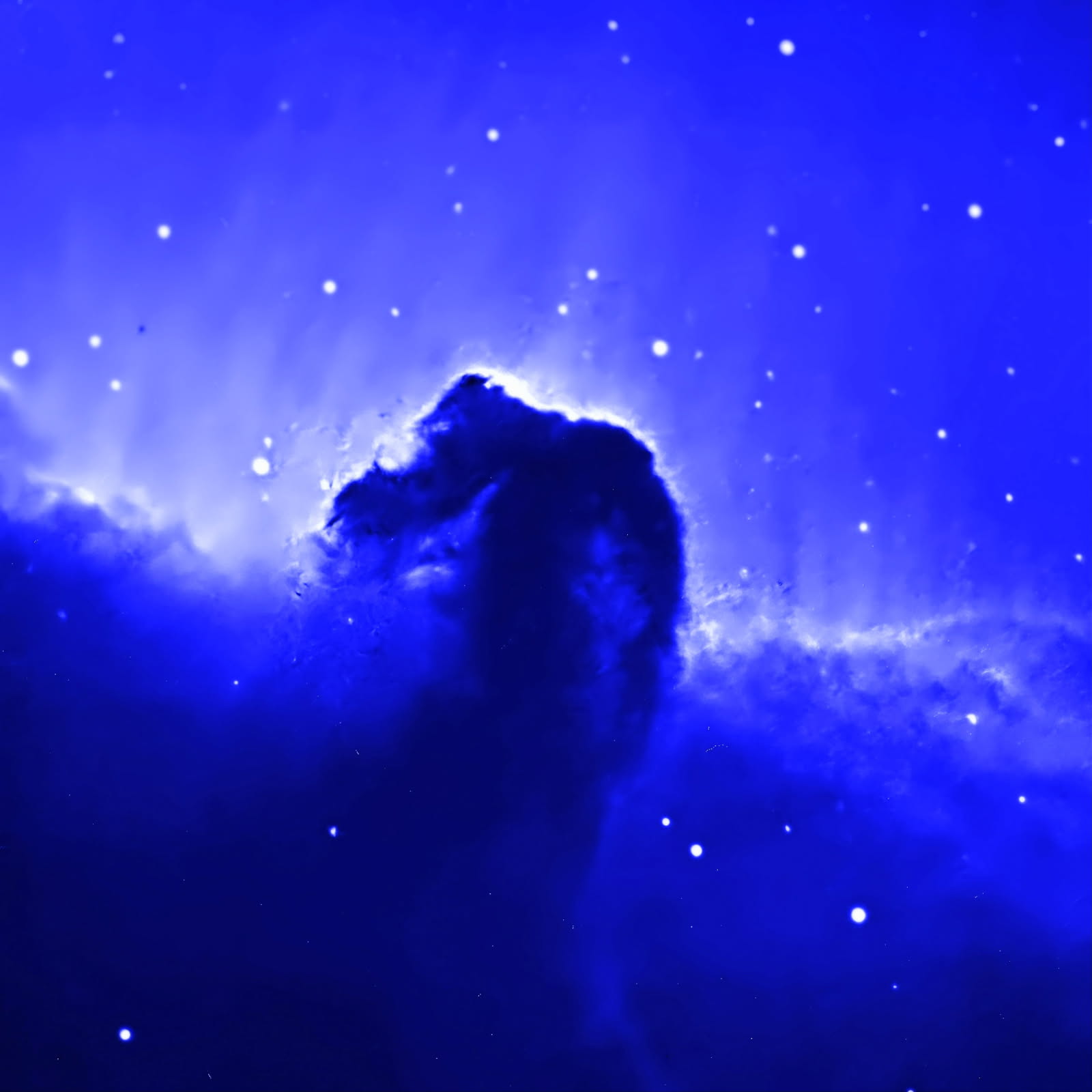
Horsehead Nebula Close-up
The Horsehead is one of the most recognisable objects in the night sky, and it is visible only because something brighter happens to be glowing behind it. A cold, opaque column of molecular dust looms in silhouette against a wall of ionised hydrogen, its outline so emphatically equine that the name was inevitable. Stars are being born deep inside it even now, hidden behind the obscuring grains. Few features in astronomy so perfectly combine geometry, physics, and accident into a single iconic shape.
The Horsehead Nebula (Barnard 33) is a dark molecular cloud in the constellation Orion, silhouetted against the bright emission nebula IC 434 in the Orion B cloud complex. Its distance is approximately 1,375 light-years and the visible silhouette spans about 3.5 light-years in physical size. The nebula has no integrated visual magnitude in the conventional sense because it is a dark absorbing structure, but it is easily photographed because of the bright Hα background produced by IC 434, ionised by the nearby hot star σ Orionis. The opaque ‘head’ is composed of cold dense molecular gas and dust that obscures background starlight; active star formation is occurring inside it, with several young protostars detected by Spitzer and other infrared observatories. The Horsehead is slowly being eroded by ultraviolet radiation from the hot stars of the Orion OB1 association and is expected to dissipate over the next few million years. The region is well placed for northern-hemisphere imaging from late autumn through early spring.
Personal commentary from George — coming soon. How the image was captured, what he likes about the result, and where he would like to take it next.
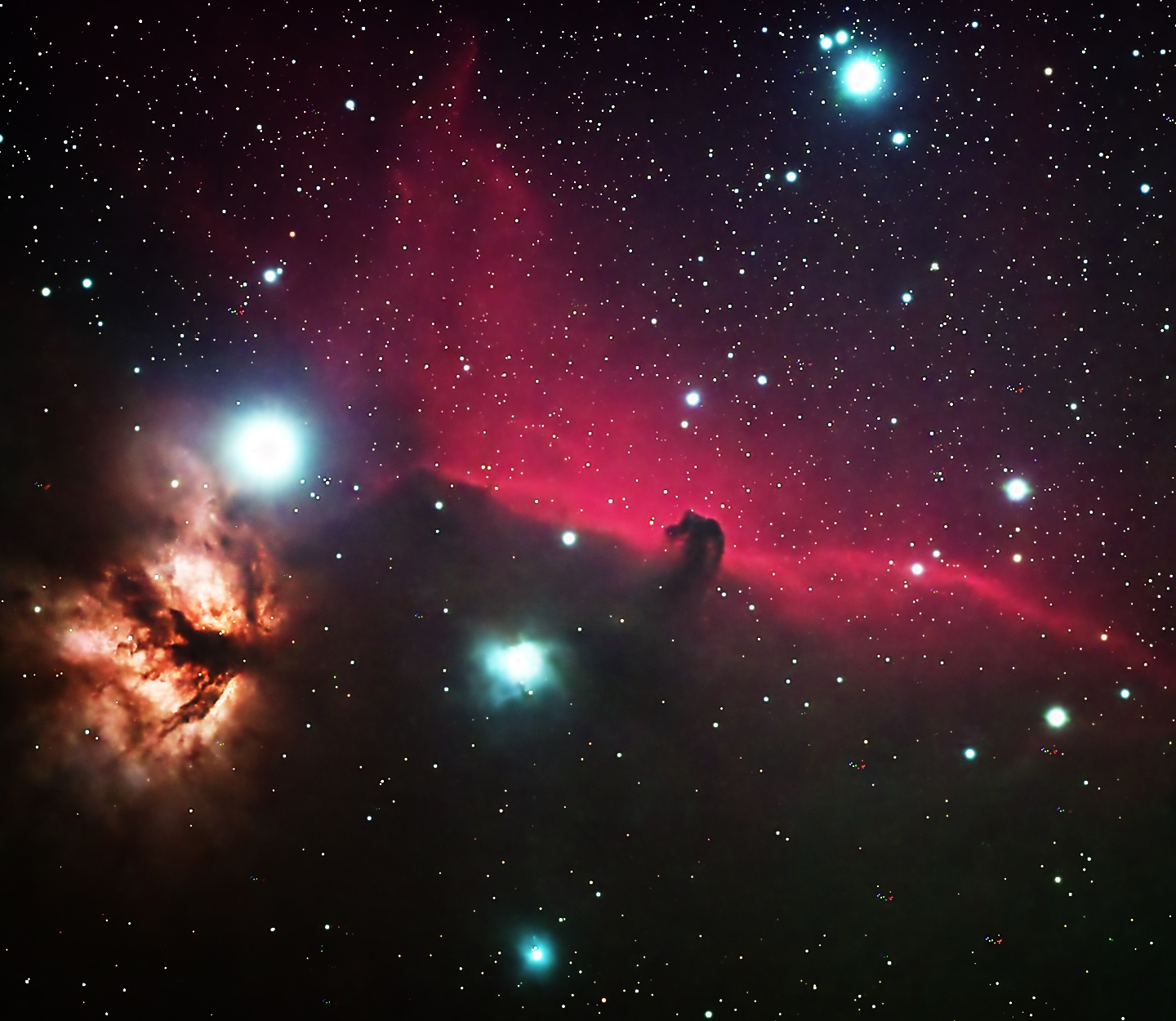
Horsehead and Flame Nebula Region
The wide view of the Horsehead and Flame is one of the most concentrated patches of astronomical wonder anywhere in the sky. In a single field the eye takes in two famous nebulae, lanes of obscuring dust, the bright blue supergiant Alnitak anchoring the lower belt of Orion, and a tangled background of newborn stars still wreathed in the gas that made them. This is a working stellar nursery laid out in one frame, and it is no exaggeration to say that hundreds of stars currently being assembled inside it would be visible if the dust were not in the way.
The Horsehead and Flame Nebula region lies in the constellation Orion, near the easternmost belt star Alnitak (ζ Orionis). The Horsehead (Barnard 33) is a dark molecular cloud silhouetted against the emission nebula IC 434, while the Flame Nebula (NGC 2024) is an emission nebula bisected by a prominent dark lane of obscuring dust. Both are part of the Orion Molecular Cloud Complex at a distance of approximately 1,375 light-years. The Flame Nebula is illuminated by ultraviolet radiation from Alnitak, an O9.7 supergiant whose own light, scattered by nearby optics, frequently complicates imaging this region. Deep infrared surveys have revealed an embedded cluster of more than 800 young stellar objects inside NGC 2024, many of them still surrounded by accretion discs. The wider field also includes NGC 2023, a bright blue reflection nebula below the Horsehead. The region spans roughly 1.5° on the sky, well suited to wide-field astrographs, and is best imaged from late autumn through early spring in the northern hemisphere.
An old chestnut and immediately recognisable. I pointed the RedCat 91 at this region on 25 January 2025, early in my experiments with colour filters — the narrowband filters were still in their boxes. About seventy-five LRGB subframes through the ASI533MM Pro, weighted roughly 20/20/10/20 with green the thinnest. I think spectrophotometric calibration in PixInsight is what carried it. What I value most is what the image taught me: that a small refractor is much easier to live with than a big reflector — lighter, faster, and able to take in far more sky. There’s plenty I’d do differently in post now, and one day I’d like to revisit the whole region with narrowband.
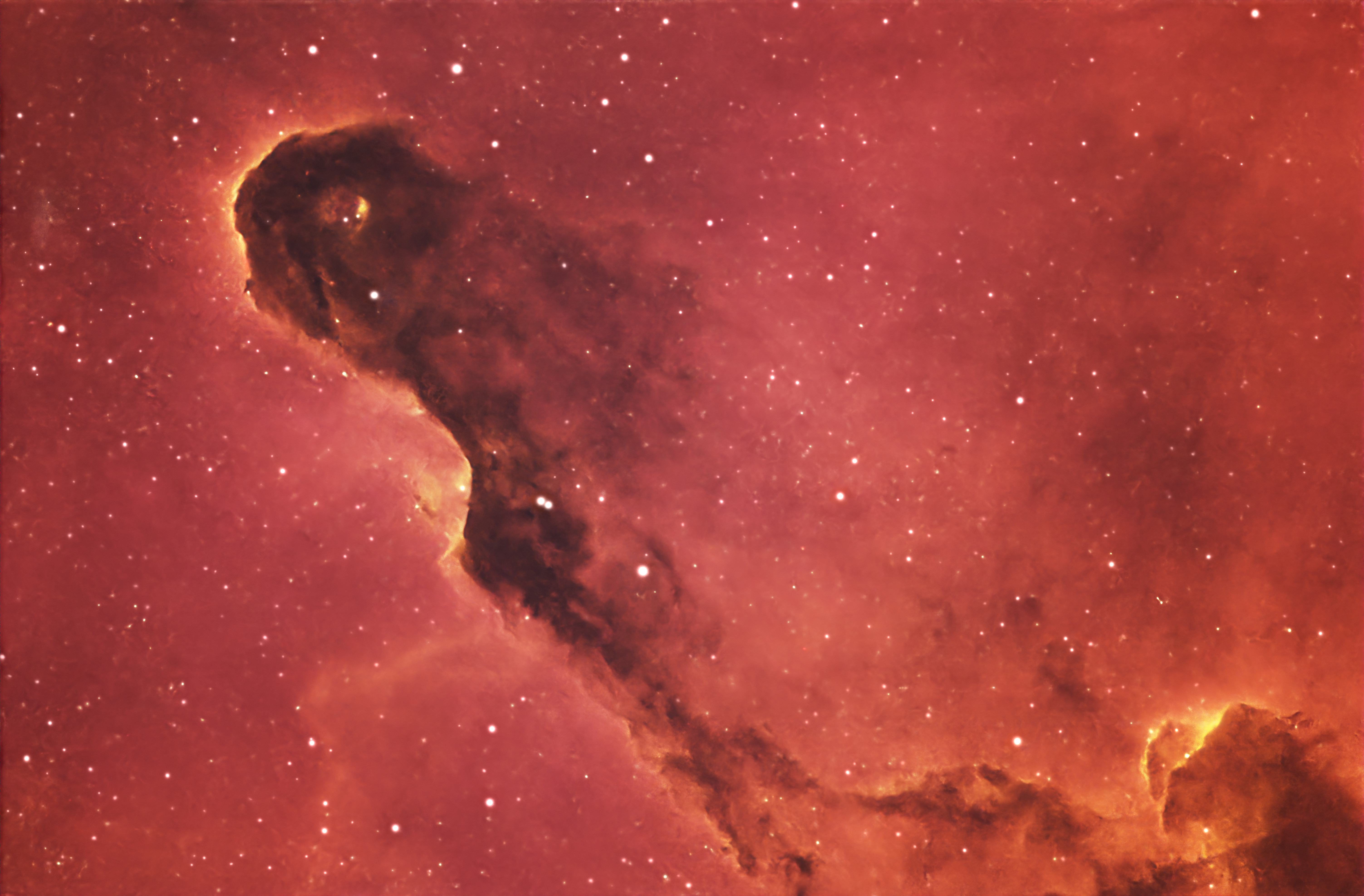
Elephant’s Trunk Nebula (IC 1396A)
The Elephant’s Trunk is one of the most evocative structures in the entire interstellar medium — a tapering finger of dark molecular gas pushing twenty light-years out of the side of a far larger emission region in Cepheus. Its bright illuminated rim is being carved and eroded by ultraviolet radiation from massive stars several light-years away, and inside its dense head new stars are still being assembled. Few objects so vividly demonstrate that the spaces between the stars are not empty but alive with slow, violent geology of their own.
The Elephant’s Trunk Nebula (IC 1396A) is a dense globule of interstellar gas and dust embedded within the much larger emission nebula IC 1396 in the constellation Cepheus. The complex lies at a distance of approximately 2,400 light-years. The trunk itself extends roughly 20 light-years in length and is being ionised on its illuminated rim by ultraviolet radiation from the massive multiple star HD 206267, an O-type system in the centre of the wider IC 1396 region. The structure is a textbook example of a bright-rimmed globule, an early stage in the morphology that produces classic cometary globules and pillar-of-creation shapes. Spitzer and Herschel infrared observations have revealed multiple Class I and Class II young stellar objects inside the trunk, indicating active ongoing star formation — the cloud is in effect giving birth to stars while being eroded out of existence. The broader IC 1396 spans roughly 3° on the sky, more than five times the area of the full Moon. Narrowband Hα, [O III], and [S II] imaging brings out the layered ionisation structure of the bright rim. The region is best imaged from northern summer through autumn.
This is a recent one. The Elephant’s Trunk is just a famous object that had to come through the lens eventually, and it made a convenient passage from the balcony. Through the Celestron 14 EdgeHD on the CGX-L mount with the ASI2600MM Pro, I took 14 frames each of Hα, OIII and SII at two minutes — no rejections — and then about thirty minutes more Hα assigned to the luminance channel to keep the stars sharp. Total around two hours. I ended up with an orange-mandarin palette I’m not entirely settled on; next time I’d lean closer to the familiar Hubble palette. The stars come through pinpoint-sharp thanks to the Esatto focuser.